Technology & Solutions

Redefining timely and accurate liver fibrosis detection based on accessible patient data

LiverPRO™

LiverPRO is a data-driven and evidence-based Software as a Medical Device (SaMD) that ensures timely, accurate, and cost-efficient detection of liver fibrosis. It combines age with data from at least three to nine common blood-based biomarkers to produce an easily interpretable liver fibrosis risk score, a risk category, and clinical recommendation on next steps.

Based on clinical research, it delivers high diagnostic performance while broadening patient access, addressing late diagnosis and segmentation challenges in undiagnosed patients.

LiverPRO is CE-certified (IVDR Class-B) and is being deployed to benefit patients, physicians, and healthcare systems. It also supports clinical trials advancing treatments for steatotic liver disease.

LiverPRO is a CE-certified medical device according to the In Vitro Diagnostic Regulation (IVDR Class B), allowing clinical implementation across Europe. This is also widely accepted in many other markets.

Evido Health is certified accordingly to ISO 13485 Quality Management System for Medical Devices, allowing Evido Health to design, develop, produce, and distribute in-vitro diagnostic software.

LiverPRO in numbers
30
Scientific studies featuring LiverPRO
52
M
Individuals evaluated using LiverPRO
30
k
Biopsies used validating LiverPRO
LiverPRO™

Services and LiverPRO deployments

Detect undiagnosed liver fibrosis in clinical practice

Key benefits

01.
Strong diagnostic performance in detecting liver fibrosis, outperforming other first-line non-invasive tests in the field.1
02.
Optimised referral pathway, enabling significant reduction of false positive referrals compared to current international clinical guidelines2. LiverPRO is also validated in sequential pathways with  other tests such as ADAPT, ELF, and VCTE, optimising for cost while ensuring both high sensitivity and specificity.
03.
Automatically processed and directly compatible with existing patient consultations and touch points by utilising routine blood tests and being integrated in laboratory information system (LIS) or Electronic Health Record (EHR) system.
04.
Adaptable to local (healthcare or regional specific) availability of laboratory tests due to an adaptive model hierarchy, enabling processing on minimum three out of nine blood-based input variables.
05.
Regulatory approved for clinical use and mentioned in international guidance enabling broad clinical adoption.3,4
71
%
Reduction in unnecessary referrals compared to FIB-4 (age-adjusted)2,5
29
%
Reduction of costs compared to FIB-4 (age-adjusted) pathway2,5

Related publications

Directly compatible with existing clinical workflow

LiverPRO is a software solution that integrates into the backbone of the healthcare data infrastructure, supporting existing clinical workflows of at-risk patients and enabling direct liver fibrosis stratification based on already sampled healthcare data.

Intended patient group
One or more of following risk factors:
Alcohol overuse
Metabolic syndrome
Obesity
Type 2 diabetes
01 Patient consultation
LiverPRO leverages the blood test results that are already sampled during existing consultations with at-risk patients.
Blood sampling
(patient consultation)
LiverPRO is ordered as a regular blood test
02 Laboratory analysis
LiverPRO is integrated centrally to provide automated processing and enable reflex testing.
Centralised blood
analysis
LiverPRO is automatically processed
03 Follow up consultation
LiverPRO results are delivered as part of the laboratory report directly in the clinician’s EHR system.
LiverPRO results are delivered directly in the EHR system
1Lindvig, K. P., et al. (2025). The Lancet Gastroenterology & Hepatology. DOI:10.1016/S2468-1253(24)00274-7
2European Association for the Study of the Liver (EASL), European Association for the Study of Diabetes (EASD), & European Association for the Study of Obesity (EASO),  (2024). Journal of Hepatology. DOI: 10.1016/j.jhep.2024.04.031
3Pieter B. W., et al. (2026).  JHEP Reports: Innovation in Hepatology. DOI: 10.1016/j.hepr.2026.101798
4Karlsen, T. H., et al. (2026). The Lancet. DOI: 10.1016/S0140-6736(26)00138-8
5Thorhauge, K., et al. (2026). Clinical Gastroenterology and Hepatology. DOI: 10.1016/j.cgh.2026.01.024

Accelerate enrolment and increase subject access for clinical trials

Key benefits

01.
Optimises enrolment rate and reduces screen failure rates by adding an accurate stratification as first-line testing and/or pre-screening.
02.
Broadens and enriches the screening funnel by unlocking new patient channels based on routine and historical laboratory data from Electronic Health Record (EHR) systems, registries, partnering sites, and more.
03.
Enables broader and more representative population screening by leveraging routine blood samples and open efficient pre-screening outside of specialist care.
04.
Streamlines trial site operations by enabling data-driven and automated evaluations of thousands of patients in seconds.
05.
Compatible with current trial recruitment practice, providing support for various site characteristics.
79
%
Reduction in biopsy screen failures compared to traditional screening approach1
86
%
Proportion of data from EHR systems that can be processed to calculate LiverPRO2

Related publications

LiverPRO pre-screening service

An end-to-end pre-screening service including everything from site vetting, data quality check, data processing, and candidate prioritisation. The service centres around the LiverPRO technology that leverages historical laboratory data to increase the screening funnel and optimise enrolment by unlocking new patient sources.

00 Deployment of LiverPRO pre-screening setup
LiverPRO vetting process: vetting of data availability and quality at a site level.
LiverPRO configuration: defining specific pre-screening setup together with sponsor.
Site onboarding: onboarding eligible sites for pre-screening service.
01 Ongoing pre-screening
Increase screening volume by enabling data-driven detection of liver fibrosis based on historical patient data from EMR/EHR.
Enable specific liver fibrosis target already from pre-screening by configuring LiverPRO to the specific study need.
Partner site EHR
(e.g., primary care or endocrinology)
Public patient registries
CRO/SMO patient databases
Trial site EHR or database
LiverPRO Cloud
(EMR/EHR processing)
02 Screening
Identified screening candidates are prioritised according to study target and exclusion criteria.
Optimise site operations by focusing screening activities on the right candidates.
Screening visit

(trial site)
03 Enrolment benefits
Reduce screen failures by adding a qualifying pre-screening assessment.
Accelerate enrollment by enabling screening of new patient sources in a scalable and efficient manner.
Subject intervention and tracking
1Hartman, M. L., et al. (2025). Abstract presented as poster at the EASL Congress 2025, Amsterdam (Netherlands)
2Astono, J., et al. (2026). Abstract presented as poster at the EASL Congress 2026, Barcelona (Spain)

Uncover true disease burden and treatment effect from historical real-world data

Key benefits

01.
Enables accurate liver fibrosis prevalence estimates from existing claims, Electronic Medical Records (EMRs), and registries to strengthen the understanding and awareness of diagnostic gaps and high-risk patient populations.
02.
Unlocks clinical insights from real-world data sources on liver fibrosis trajectories at population scale, progression/regression insights for HEOR simulations, and comparative effectiveness studies.
03.
Supports outcome modelling and targeted intervention planning by activating real-world data on high-risk subgroups for liver events and mortality.
04.
Directly compatible with large data registries by complying with standard healthcare protocols.
05.
Unlocks heterogenous databases with inconsistent or missing laboratory values by leveraging the flexibility of adapting to missing data.
39
%
Better processing coverage than FIB-4 based on available patient data in registries1
3.6
X
Greater separation between high- and low-risk groups for liver events compared to FIB-42

Related publications

Enrichment of real world data

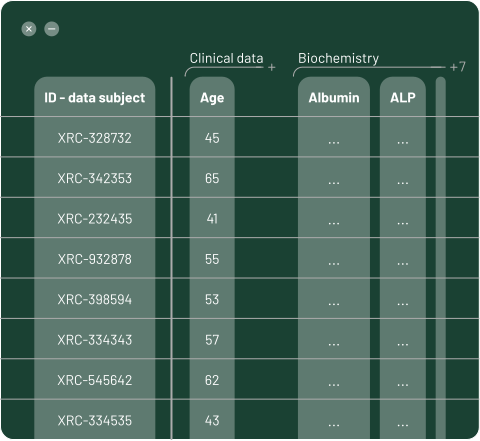
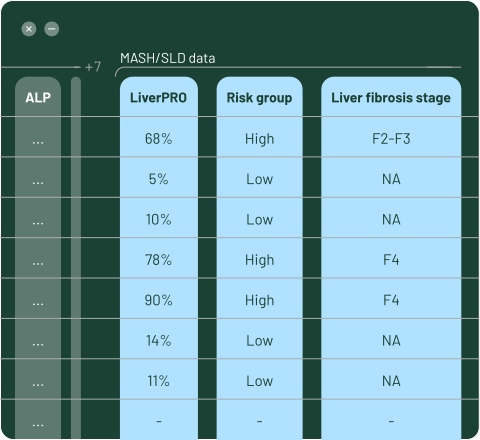
LiverPRO can analyse diverse patient cohorts through its adaptive input functionality, expanding the real-world evidence scope across international datasets. This flexibility extracts liver fibrosis insights from fragmented data sources, which have previously been discarded due to panel inconsistencies or regional lab variations.
01 Data sources
Enable the use of large registries and datasets to support real-world evidence and market access activities.
Public patient registries
Sponsor databases
Laboratory databases
Clinical study dataset
01 Data extraction and preparation
Build real-world evidence on non-liver specific data.
On-premise or remote deployment and processing of LiverPRO.
02 Data enrichment
Enrich database with liver fibrosis information.
Simulate local prevalence numbers and disease burden.
Facilitate observational study on treatment effect on approved compounds.
Bring evidence for awareness and Health Economics and Outcome Research (HEOR) submissions.
1Schattenberg, J. M., et al. (2026). Abstract presented as poster at the EASL Congress 2026, Barcelona (Spain)
2Lindvig, K. P., et al. (2024). Abstract presented as poster at the EASL Congress 2024, Milan (Italy)
LiverPRO™

Directly compatible with Laboratory Information Systems (LIS) and EHR infrastructure

LiverPRO is a Software as a Medical Device (SaMD) that consists of a software platform and a state-of-the-art prediction model. The platform enables seamless integration to various systems and environments, while the model is built and proven for accurately detecting liver fibrosis.

LiverPRO is designed to be easy to access, use, and scale which is necessary to overcome current key gaps in ensuring timely detection of undiagnosed patients with liver fibrosis.

LiverPRO™

Core features

LiverPRO™

Explore LiverPRO yourself
Configuration
Example

LiverPRO is configurable for specific fibrosis targets. This impacts what cut-offs are used.

LiverPRO can be deployed in different contexts, adapting to the available and relevant input variables.

LiverPRO is a flexible model that automatically adapts to whichever three or more biomarkers that are available out of the nine possible per individual, representing the versatile functions of the liver.

In addition to minimum three biomarkers, the only mandatory input variable is age.

This data is retrieved from already sampled blood tests.

Targeted fibrosis stage(s)

LiverPRO is configurable for specific fibrosis targets. This impact what cut-offs are used.

≥F2
Context of deployment

LiverPRO can be deployed in different contexts, adapting to the available and relevant input variables.

Endocrinology/Obesity
Input variables

LiverPRO is a flexible model that automatically adapts to whichever three or more biomarkers that are available out of the nine possible per individual, representing the versatile functions of the liver.

In addition to minimum three biomarkers, the only mandatory input variable is age.

This data is retrieved from already sampled blood tests.

Age*
44
years
Albumin
46
g/L
Alkaline phosphatase (ALP)
80
U/L
Aspartate transaminase (AST)
47
U/L
Bilirubin
µmol/L
Cholesterol (Total)
5.0
mmol/L
Gamma-glutamyl transferase (GGT)
U/L
International normalised ratio (INR)
0.89
U/L
Platelet count
250
109/L
Sodium
mmol/L
Waiting for your selections
Please make your selections for an illustrative example of the LiverPRO outputs
Generating outputs
Please wait for an illustrative example of the LiverPRO outputs
LiverPRO score
0-100
%
LiverPRO cut-offs
Fibrosis target
XX
LiverPRO risk categories and clinical recommendations
For low risk, consider repeating testing in 2-3 years if lifestyle risk factors persists.
For moderate risk, intervene on lifestyle and repeat testing in 6-12 months.
For high risk, consider referring the patient for specialist evaluation.
Moderate risk
Intervene on lifestyle and repeat testing in 6-12 months.
Key clinical drivers
Excretion
Metabolism
Portal hypertension
Synthesis
Note: This is a conceptual visualisation of the LiverPRO results. In real-world implementations, the LiverPRO results will be delivered directly into the Electronic Health Record (EHR) system.

Trusted, used, and supported throughout the ecosystem